
IVF Journey Timeline Estimator
Customize Your Path
Your Detailed Roadmap
Click a phase above to see detailed expectations
Waiting for a baby to arrive is stressful enough, but when you're navigating the complex world of fertility treatments, the clock feels like it's ticking slower than usual. You might be wondering if you'll be pregnant by next month or if this process will take a year of your life. The truth is, there is no single "IVF calendar" that fits everyone. While the core medical steps follow a specific sequence, your body's response to medication and the timing of your cycles can shift the goalposts.
If you're looking for a ballpark figure, a single cycle of IVF timeline usually spans about 6 to 12 weeks from the first injection to the pregnancy test. However, that's just the biological window. The actual journey-including the prep work, the emotional rollercoaster, and the potential for multiple attempts-often takes longer. Let's break down exactly what happens during those weeks so you know what to expect.
To start, In Vitro Fertilization is a complex series of procedures used to help with fertility or prevent genetic problems when using eggs and sperm to help a woman or a couple get pregnant. Also known as IVF, this method involves fertilizing an egg outside the body in a laboratory setting before transferring the resulting embryo back into the uterus.
Key Takeaways: The IVF Timeframe
- One Cycle: Typically 6 to 12 weeks from start to pregnancy test.
- Preparation: 1 to 2 months of initial testing and medication synchronization.
- The "Two-Week Wait": The critical gap between embryo transfer and the pregnancy test.
- Overall Journey: Can range from 3 months to several years depending on success rates.
Phase 1: The Warm-Up and Preparation
You don't just walk into a clinic and start IVF the next day. Before the needles come out, your doctor needs a baseline. This phase usually takes 4 to 8 weeks. You'll undergo blood tests to check your hormone levels and an ultrasound to count your antral follicles-the tiny sacs where eggs grow.
Depending on your cycle, your doctor might put you on birth control pills or estrogen for a few weeks. This isn't for contraception; it's to "quiet" your ovaries and synchronize your cycle so the clinic can time the stimulation phase perfectly. If you're using a donor or have a partner with low sperm count, this is also when the Sperm is collected and frozen.
Phase 2: Ovarian Stimulation (The 10-12 Day Sprint)
This is the most intense part of the process. For about 10 to 12 days, you'll inject hormones (like FSH and LH) to encourage your ovaries to produce multiple eggs instead of just one. You'll visit the clinic every few days for monitoring. Your doctor will use an ultrasound to see how the follicles are growing. If they grow too fast or too slow, the medication dose is tweaked on the fly.
The phase ends with a "trigger shot"-usually HCG or a Lupron agonist. This shot is timed precisely to the hour because it tells the eggs to finalize their maturation. You must have the egg retrieval exactly 36 hours after this shot, or you risk the eggs being released naturally (ovulation), which would ruin the cycle.
Phase 3: Egg Retrieval and Fertilization
The Egg Retrieval is a quick surgical procedure. While you're under light sedation, the doctor uses a needle guided by ultrasound to collect the fluid from the follicles. This takes about 30 minutes.
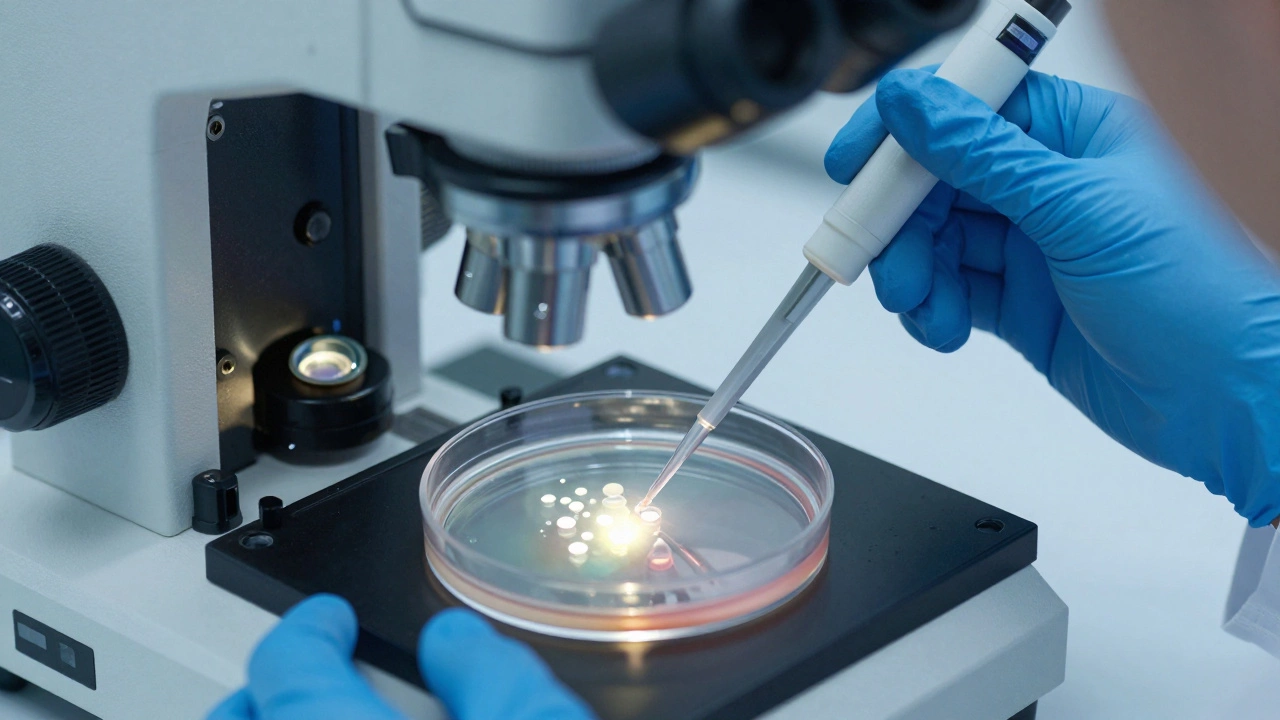
Once the eggs are out, they head to the lab. This is where Insemination happens. The embryologist combines the eggs and sperm in a petri dish. If fertilization is difficult, they may use ICSI (Intracytoplasmic Sperm Injection), where a single sperm is injected directly into the egg. You'll usually get a call the next day telling you how many eggs fertilized successfully.
Phase 4: Embryo Development and The Big Decision
Now, the embryos grow in an incubator. Most clinics wait until the "Blastocyst" stage, which is Day 5 or 6 after fertilization. At this point, the embryo has hundreds of cells and is more likely to implant successfully.
This is where you hit a fork in the road: a Fresh Transfer or a Frozen Transfer. In a fresh transfer, the embryo is placed in the uterus immediately. In a frozen transfer, the embryos are cryopreserved using Vitrification (flash-freezing).
Many doctors now prefer frozen transfers. Why? Because the high doses of stimulation hormones from Phase 2 can make the uterine lining less receptive. Freezing the embryos allows your body to recover and lets the doctor prepare your lining with progesterone and estrogen for a better chance of success.
| Feature | Fresh Transfer | Frozen Transfer (FET) |
|---|---|---|
| Timing | 5 days after retrieval | Weeks or months later |
| Body State | Hormone-heavy (Stimulated) | Recovered/Controlled |
| Prep Time | None | 1-4 weeks of lining prep |
| Success Rate | Varies by patient | Often higher for certain ages/conditions |

Phase 5: The Transfer and the Two-Week Wait
The Embryo Transfer is the easiest part of the process. It's similar to a pap smear; a thin catheter is used to place the embryo into the uterus. There's no anesthesia and it takes about five minutes.
Then comes the most grueling part: the Two-Week Wait (2WW). You have to wait about 10 to 14 days before taking a blood test (Beta-HCG) to see if the embryo implanted. Testing too early can give a false negative because the hormone levels haven't peaked yet. This is the window where you'll find yourself Googling every tiny cramp or mood swing.
Why Some Journeys Take Longer
If you didn't get a positive result on the first try, the timeline extends. Some people need a "mock cycle" to see how their lining reacts. Others might deal with OHSS (Ovarian Hyperstimulation Syndrome), which can force a clinic to freeze all embryos and wait months before a transfer to ensure patient safety.
There's also the reality of multiple attempts. While some get lucky the first time, others may go through 2, 3, or more cycles. If you're using PGT-A (Preimplantation Genetic Testing), you have to wait an additional 2 to 3 weeks for the genetic results to come back from the lab before you can even schedule the transfer.
Can I get pregnant faster with IVF than naturally?
Not necessarily. While IVF is a more controlled process, the actual time from "starting the process" to "being pregnant" is often longer than trying naturally because of the medical prep and the specific timing of the transfer. However, for those with severe fertility issues, IVF is the fastest (and sometimes only) reliable path to pregnancy.
What is the average success rate per cycle?
Success rates vary wildly based on age. For women under 35, the chance of a live birth per transfer is significantly higher (often 50% or more). For women over 40, the rate drops considerably. This is why some people spend years on the IVF journey, as they may need multiple retrievals to find one genetically viable embryo.
How long should I wait before starting the next cycle if the first fails?
Most doctors recommend waiting at least one full menstrual cycle to allow your hormones to reset and your ovaries to return to their normal size. This "rest period" helps ensure that the next stimulation phase is effective and safe.
Does the "Two-Week Wait" always take exactly 14 days?
Usually, yes. Although some people try home pregnancy tests after 5 or 7 days, doctors insist on the 10-14 day window because HCG (the pregnancy hormone) takes time to build up in the bloodstream after the embryo implants. Testing too early often leads to heartbreak over a false negative.
How long does the genetic testing (PGT) take?
Genetic testing typically adds 10 to 21 days to your timeline. The embryo is biopsied, the cells are sent to a specialized lab, and the results are sent back to your clinic. You cannot perform a transfer until these results are confirmed.
Next Steps and Troubleshooting
If you're just starting, your first step is a comprehensive fertility workup. Don't rush into the stimulation phase without knowing your AMH (Anti-Müllerian Hormone) levels, as this dictates how your doctor will dose your medications.
If you're currently in the "wait" phase and feeling anxious, focus on low-impact activity. Avoid extreme exercise or heavy lifting immediately after a transfer, as your body needs to prioritize blood flow to the uterus. If you experience severe bloating or shortness of breath after retrieval, contact your clinic immediately, as these can be signs of OHSS.
For those who have had a failed cycle, the next step is usually a review meeting. Your doctor will look at the embryo quality and the uterine lining to decide if you need a different protocol-such as switching from a natural cycle to a medicated cycle-to improve the odds for the next round.

Write a comment