
International Travel Coverage Analyzer
Why use this? Medicare rarely covers care outside the US. This tool helps you identify if you are financially exposed during your trip.
You just booked that dream trip to Europe or a medical procedure in Thailand. You packed your passport, your clothes, and your wallet. But there’s one piece of plastic sitting in your drawer that you’re wondering about: your Medicare card. Do you need it? Should you carry it? And most importantly, will it actually help if something goes wrong while you’re thousands of miles from home?
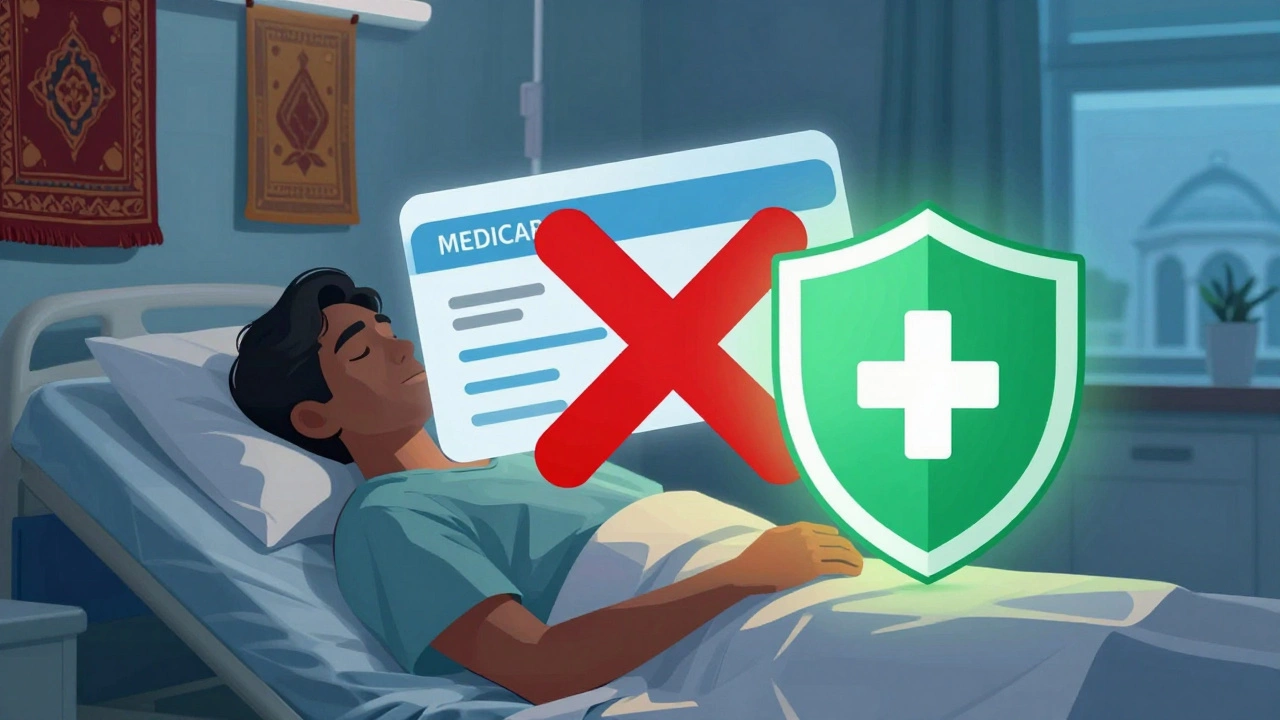
The short answer is no, your Medicare card will not pay for your hospital bills overseas. In fact, relying on it could leave you with a massive financial shock. However, carrying a copy of it might still be a smart move for specific reasons. Let’s break down exactly how Medicare works when you cross borders, what happens during medical tourism, and what you should actually pack to stay safe.
How Medicare Works Outside the United States
To understand why your card won’t work in Paris or Tokyo, we first need to look at what Medicare actually is. Medicare is a federal health insurance program primarily for people aged 65 and older, as well as some younger people with disabilities. It is designed to cover healthcare services within the United States and its territories (like Puerto Rico and Guam).
When you step onto an airplane bound for another country, your standard Medicare coverage effectively turns off. There are very few exceptions. Medicare Part A (hospital insurance) and Part B (medical insurance) generally do not cover foreign countries. This means if you break your leg skiing in Switzerland or get food poisoning in Mexico, Medicare will not send a bill to the hospital on your behalf. You will be responsible for 100% of the cost upfront.
There are two rare scenarios where Medicare might offer a tiny bit of help, but they are so specific that most travelers never qualify:
- Border Hospitals: If you live near the Canadian border and the closest hospital that can treat an emergency is in Canada, Medicare Part A might cover inpatient care. But only if you cannot get timely care in the U.S.
- Cruise Ship Emergencies: If you are injured on a cruise ship between two ports in the U.S., Medicare might cover the cost. But if the ship is in international waters or heading to a foreign port, you are on your own.
For everyone else traveling internationally, whether for vacation or medical procedures, standard Medicare is useless. Don’t let the logo on your card fool you into thinking you have global protection.
Why You Might Still Want to Carry a Copy
If Medicare doesn’t pay, why bother bringing the card at all? Here is where it gets practical. While Medicare won’t write a check, your personal information matters. Many Americans who have Medicare also have secondary insurance, such as a retiree plan through their former employer, a Veterans Affairs (VA) benefit, or a private supplemental policy.
Your Medicare card contains your unique identification number. Some foreign hospitals or clinics may ask for this number for administrative records, even if they know Medicare isn’t paying. More importantly, if you have a supplemental insurance plan (like a Medigap policy), that insurer might require proof of your primary Medicare status before they agree to reimburse you for out-of-pocket expenses incurred abroad. Note that many Medigap plans also exclude foreign travel, so you must check your specific policy details.
I recommend keeping a digital copy of your Medicare card in a secure cloud folder and a physical photocopy in your wallet. Do not carry the original card unless absolutely necessary, as losing it while abroad creates a bureaucratic nightmare to replace. If you do carry the original, keep it separate from your passport.
The Real Solution: Travel Health Insurance vs. Medigap
Since Medicare leaves you exposed, you need a safety net. This is where the confusion often lies. People think their Medigap plan covers them everywhere. It usually doesn’t. However, some Medigap plans (C, D, E, F, G, M, and N) offer limited foreign travel coverage. This typically kicks in after a $250 deductible and covers 80% of costs, up to a lifetime limit of $50,000. It sounds good, but it has strict rules: it only applies to emergencies, lasts a maximum of 60 days per trip, and starts after the first 60 days of continuous travel. For a short vacation, this gap might leave you uncovered.
This is why dedicated Travel Health Insurance is a specialized policy designed to cover medical expenses, emergency evacuation, and trip cancellation while traveling outside your home country. Unlike Medicare, these policies are built for international use. They cover emergency room visits, doctor consultations, and crucially, medical evacuation. Imagine being in a remote area in Costa Rica and needing to be flown back to the U.S. for surgery. That flight alone can cost $50,000 to $100,000. Medicare won’t touch that. A good travel insurance policy will.
| Feature | Standard Medicare | Medigap Foreign Travel Benefit | Dedicated Travel Insurance |
|---|---|---|---|
| Covers Routine Care Abroad | No | No | Usually No (Emergency Only) |
| Covers Emergency Room Visits | No | Yes (Limited) | Yes |
| Medical Evacuation | No | No | Yes (Critical Feature) |
| Lifetime Limit | N/A | $50,000 | Varies ($100k - $1M+) |
| Pre-existing Conditions | N/A | Excluded | Often Excluded (Check Policy) |
Medical Tourism: A Different Ballgame
If you are traveling specifically for Medical Tourism is the practice of traveling to another country to receive medical treatment, often at a lower cost than in the patient's home country., the rules change slightly. You aren’t just hoping for an emergency; you are planning for a procedure. Whether it’s dental work in Mexico, heart surgery in India, or cosmetic surgery in Turkey, you are entering a contractual relationship with a foreign provider.
In this scenario, your Medicare card is completely irrelevant to the payment process. The clinic in Bangkok does not bill Medicare. You pay them directly. The question then becomes: what if the surgery goes wrong? What if you develop an infection three weeks later after returning home?
Here is the hard truth: most standard travel insurance policies explicitly exclude elective procedures and complications arising from them. If you go abroad for a knee replacement and it fails, your travel insurance likely won’t cover the revision surgery. You are relying entirely on the warranty or guarantee offered by the foreign clinic. Always ask the clinic about their "complication policy." Do they cover follow-up care? Do they cover flights home if you need further treatment?
Some specialized medical tourism facilitators offer comprehensive packages that include post-operative care in the U.S. This is far more valuable than your Medicare card. Never assume that because Medicare covers the same procedure in the U.S., it will cover the aftermath of a foreign procedure. It won’t.
Practical Steps Before You Fly
So, what should you actually do? Here is a checklist to ensure you are protected without overpaying for unnecessary coverage.
- Check Your Medigap Plan: If you have a Medigap plan, call your insurer. Ask specifically: "Does my plan cover foreign travel emergencies? What is the deductible? Is there a waiting period?" Write down the answers.
- Buy Dedicated Travel Insurance: If your Medigap plan has gaps (which it likely does), buy a standalone travel medical insurance policy. Look for one that includes high limits for medical expenses ($100,000+) and medical evacuation ($250,000+). Companies like Allianz, World Nomads, or IMG offer these.
- Carry Documentation: Pack a photocopy of your Medicare card, your new travel insurance policy documents, and a list of your current medications and allergies. Keep these in your carry-on bag, not your checked luggage.
- Know Your Network: If you are going for medical tourism, verify that the hospital is accredited by international bodies like Joint Commission International (JCI). This ensures they meet safety standards similar to those in the U.S.
- Emergency Contacts: Save the phone number of your travel insurance provider’s 24/7 assistance line. In an emergency, call them before going to the hospital. They can direct you to approved facilities and may pay bills directly, saving you from draining your savings account.

Common Mistakes to Avoid
I see people make the same mistakes every year. The biggest one is assuming that because they have "insurance," they are covered. Medicare is not universal; it is geographically restricted. Another mistake is buying cheap travel insurance that looks good on paper but excludes pre-existing conditions. If you have diabetes or heart disease, you must disclose it. If you hide it, the claim will be denied when you need it most.
Also, don’t forget about prescription drugs. If you run out of insulin or blood pressure medication while abroad, you need to know how to get refills. Some travel insurance plans cover pharmacy costs, but many don’t. Bring enough medication for the entire trip plus a few extra days, kept in your original labeled bottles.
Finally, don’t rely on credit card benefits alone. Many premium credit cards offer travel accident insurance, but this usually covers accidental death or dismemberment, not medical bills. Read the fine print. It is dense, but it protects your wallet.
Conclusion: Protect Yourself, Not Just Your Card
Your Medicare card is a vital document for your health in the United States. But once you cross the border, it becomes a piece of plastic with little power. Don’t let false confidence lead to financial ruin. Understand the limits of your federal coverage, leverage your Medigap plan if applicable, and invest in robust travel health insurance. Whether you are sightseeing in Rome or undergoing surgery in Seoul, preparation is your best medicine. Pack wisely, insure adequately, and enjoy your journey with peace of mind.
Will Medicare cover me if I get sick in Canada?
Generally, no. Medicare does not cover routine or emergency care in Canada unless you live near the border and the nearest appropriate hospital is in Canada, and you cannot get timely care in the U.S. Even then, coverage is limited to Part A (hospital) services. Most Canadians and visitors rely on private travel insurance for medical costs.
Can I use my Medicare Advantage plan abroad?
Most Medicare Advantage plans do not cover care outside the U.S. However, some may offer limited emergency coverage while traveling temporarily outside your plan’s service area, including brief trips abroad. Check your plan’s Evidence of Coverage document carefully. If it doesn’t explicitly state international emergency coverage, assume it does not exist.
What should I do if I have a medical emergency abroad?
First, call your travel insurance provider’s emergency assistance number. They can guide you to the nearest appropriate facility and may arrange direct payment. If you don’t have travel insurance, seek immediate care at a reputable hospital. Pay out-of-pocket if necessary, and keep all receipts and medical records. Contact your insurer upon return to file a claim, though reimbursement is not guaranteed without prior coverage.
Does travel insurance cover pre-existing conditions?
Many standard travel insurance policies exclude pre-existing conditions. However, some insurers offer waivers if you purchase the policy shortly after booking your trip (usually within 10-21 days) and if your condition was stable during a specified look-back period (often 60-180 days). Always disclose your medical history accurately to avoid claim denials.
Is it worth buying travel insurance if I already have Medigap?
Yes, often. Medigap foreign travel coverage has a $250 deductible, covers only 80% of costs, has a $50,000 lifetime limit, and excludes the first 60 days of travel. For serious emergencies or medical evacuations, these limits are insufficient. Dedicated travel insurance offers higher limits, lower deductibles, and broader coverage, making it a wise supplement for frequent travelers or those going for extended periods.

Write a comment